

The Growth Trap: Timing Your Ultimate Exit
Every entrepreneur dreams of building something massive. You watch the revenue charts climb, the customer acquisition cost drop, and the team expand month over month. It feels incredible. The momentum is intoxicating, and the natural instinct is to ride the wave indefinitely. Why would anyone walk away when the future looks so bright?
The smartest founders do exactly that. They exit when things are going incredibly well.
Waiting until growth slows down to plan an exit is a major mistake in business. Selling a company during a growth plateau dramatically reduces its valuation and shrinks your pool of qualified buyers. Acquiring entities do not buy past achievements. They buy future potential. If you present them with a business that has flattened out, you are forcing them to figure out how to jumpstart the engine. If you hand them a rocket ship that is actively accelerating, they will pay a massive premium just to hold the controls.
Finding the right time to sell requires balancing financial metrics, market conditions, and personal readiness. Understanding the mechanics of a high-value exit helps you avoid the growth trap and maximize the value of your hard work.
What Buyers Actually Pay For
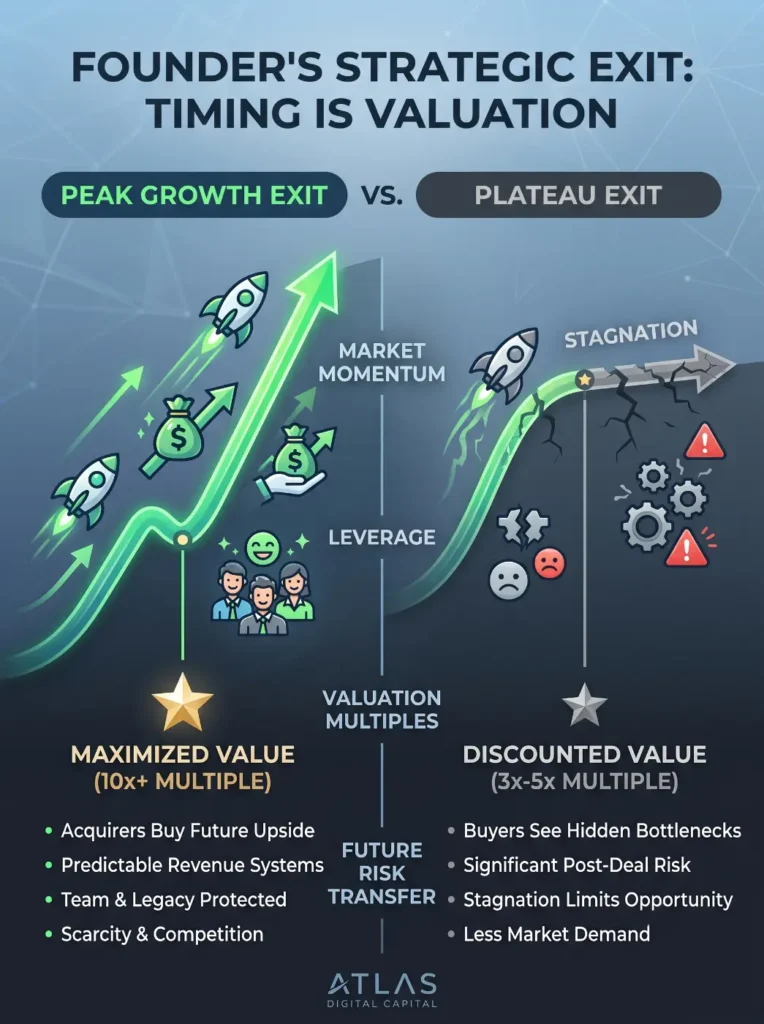
Acquirers are risk-averse by nature, but they are highly motivated by momentum. When an investment firm or a strategic competitor looks at your business, they focus heavily on your growth trajectory.
The Illusion of Stability
Many business owners assume that a stable, predictable, flat revenue stream is highly attractive to buyers. It is a comforting thought, but it rarely matches reality. Stability often looks like stagnation to an outsider. In a fast-moving economy, if you are standing still, you are falling behind.
A plateau usually signals that a business has hit a ceiling. Maybe the current market is saturated, or the customer acquisition strategy has maxed out. It could mean the technology needs a complete overhaul. Buyers spot these hidden bottlenecks instantly. They know that breaking through a plateau requires significant capital, fresh talent, and a lot of execution risk. Because they have to take on that risk, they will discount your company’s valuation to protect their downside.
Buying the Upside
When you sell during a period of rapid growth, you are selling the next chapter of your story. You are presenting a narrative supported by real, undeniable data. The buyer looks at your month-over-month growth rate and projects that line into the future. They see a clear path to getting a return on their investment.
Strategic buyers are often willing to pay a premium for growth because they can plug your accelerating asset into their existing distribution engine. If you are growing at 40% year-over-year on a lean budget, a larger competitor might look at your business and realize they can push that growth to 80% using their massive sales team. They are paying you for the velocity you built, which gives them a massive head start.
The Financial Reality of Peak Valuations
Business valuations are not just based on accounting or spreadsheet calculations. They are heavily driven by psychology, supply and demand, and timing.
Multiples Compress When Momentum Slows
Most private company valuations rely on a multiple of earnings before interest, taxes, depreciation, and amortization (EBITDA) or a multiple of total revenue. These multiples are highly elastic. They expand when a company is growing fast and contract when growth stalls.
Consider two software companies that both generate $10 million in annual recurring revenue. Company A is growing at 50% year-over-year. Company B has grown at 2% year-over-year for the past three seasons. Even though their current revenue is identical, Company A might easily command an 8x or 10x revenue multiple. Company B might struggle to secure a 3x multiple. The growth rate changes the valuation entirely. If Company A waits until it slows down to match Company B’s growth, millions of dollars in enterprise value evaporate, even if the total revenue remains high.
The Competition for Growth Assets
High-growth businesses are rare commodities. In the M&A market, plenty of stable, lifestyle businesses are up for sale, but true growth assets are hard to find. When you put an accelerating company on the market, you trigger a sense of urgency among buyers.
This scarcity creates competition. Private equity firms and corporate development teams do not want to lose a high-growth asset to their rivals. By running a competitive sales process while your metrics are soaring, you can drive up the final sale price, secure better deal terms, and keep more cash at closing.
The Risks of Holding On Too Long
It is easy to look at a growing business and assume the good times will never end. This optimism is exactly what makes founders great, but it can backfire when it comes to exit planning. Holding onto a business past its peak introduces several major risks.
Shifting Market Dynamics
No industry stays the same forever. Customer preferences shift, new regulations emerge, and macroeconomic factors can turn a hot market cold overnight. If your company is thriving in a specific niche, you can assume competitors are watching your success. Eventually, well-funded players will move into your space, or a new technology will disrupt your approach.
Selling at your peak allows you to transfer that long-term market risk to the buyer. You cash out when the market environment is ideal, leaving the next owner to navigate any future industry downturns or major competitive shifts.
Founder Burnout and the Limits of Scale
Every business requires different leadership styles at different stages of growth. The skills required to take a company from zero to $5 million in revenue are entirely different from the skills needed to scale from $5 million to $50 million.
As a business grows, it naturally becomes more complex. It requires more middle management, deeper HR infrastructure, complex legal compliance, and sophisticated financial reporting. Many founders discover that they love the early-stage building process but genuinely dislike managing a large corporate entity.
If you push through this fatigue and keep running the company anyway, burnout usually follows. When a founder burns out, execution slips, employee morale drops, and growth slows down. Selling before you hit your personal operational ceiling ensures the business stays healthy and you exit on your own terms.
Preparing the Digital Infrastructure for an Exit
To command a premium valuation at peak growth, your operational metrics must match your financial performance. Buyers will audit your entire operation during due diligence, and your digital infrastructure is often the first place they look. A business with disorganized systems or a messy digital footprint will quickly lose its premium valuation.
Scaling the Marketing Engine
A high-growth business needs a predictable, systemized way to acquire customers. If your revenue is growing simply because you are personally making every sales call, buyers will see a high-risk asset. They want to see an automated customer acquisition pipeline that functions smoothly without the founder.
This predictability requires a balanced digital marketing strategy. A strong online framework combines aggressive customer acquisition with long-term brand equity:
-
Inbound Performance: Your online visibility must show clear, upward momentum. If a buyer looks at your organic search presence and sees steady traffic growth for your core commercial terms, they know they won’t have to rebuild your web traffic from scratch.
-
Paid Acquisition Efficiency: Your paid search and digital advertising campaigns must display stable customer acquisition costs (CAC) even as your ad spend scales.
-
Conversion Systems: A website must be highly optimized for performance, loading fast and guiding visitors through a clear, measurable sales funnel.
When you can hand a buyer a high-converting website and a clear roadmap of your customer acquisition costs, you make it easy for them to justify a premium valuation. You are giving them a predictable revenue engine, not a guessing game.
Ironclad Data and Analytics
Data integrity is critical during due diligence. Buyers will review your web analytics, CRM records, and email marketing databases to verify that your growth is real.
If your tracking setup is messy or your conversion data is inaccurate, buyers will get nervous. They might wonder what else is broken under the hood. Investing in clean data tracking, professional conversion optimization, and organized marketing systems long before you open discussions with buyers prevents these issues from sinking your deal.
To build this level of operational maturity, successful founders look for guidance outside their own walls. You can read more about building a scalable framework on our About Us page, where we explain our philosophy on long-term digital growth. Our experienced specialists at Our Team work directly with businesses to clean up data tracking and optimize client acquisition pipelines.
Designing the Post-Exit Transition
Selling your company does not mean you simply walk away the day the contracts are signed. Most transactions require a transition period to ensure the business continues to run smoothly under new ownership.
The Founder’s New Role
Buyers want to know that the business can survive without you, but they also want your help handing over key relationships and institutional knowledge. This transition typically takes the form of a short-term consulting agreement or an earn-out structure, where a portion of your sale price is tied to the company’s performance over the next year or two.
Selling during a period of peak growth makes this transition much easier. Because the business has strong momentum, the new owners are under less immediate pressure to fix deep operational problems. They want you to help them keep doing what is already working, making the transition environment collaborative rather than tense.
Protecting Your Legacy and Your Team
For many entrepreneurs, a business is more than just a financial asset. It represents years of personal sacrifice, creativity, and deep relationships with employees and partners.
When you sell from a position of financial strength, you have much more leverage to negotiate protections for your team. You can pick an acquirer who shares your core values and has the resources to offer your employees better career advancement. A buyers looking at a struggling or plateaued business will often cut costs and reduce headcount immediately after closing. A buyer acquiring a high-growth company is usually looking to expand the team to keep up with consumer demand.
Navigating the Transition to Your Next Venture
Exiting a business at its peak is a major achievement, but it also marks a massive lifestyle change. The fast-paced routine of running a high-growth company disappears overnight, replaced by sudden liquidity and open calendar space.
Many founders find this transition surprisingly challenging. Preparing psychologically for life after the sale is just as important as cleaning up your financial statements. Whether you plan to invest in new industries, start another venture, or take extended time off, having a clear plan for your post-exit life prevents the identity drop that many entrepreneurs experience.
If you are looking for more strategies on building value, maximizing your web presence, and scaling digital systems, explore the guides available in our business Resources section.
Key Takeaways: Founder Exit Strategy
-
Buyers Pay for Velocity: Acquirers buy future potential, not past milestones. A business with upward momentum always commands a higher valuation than a stagnant one.
-
Plateaus Reduce Your Leverage: A flat revenue line signals hidden bottlenecks and risks to buyers, which compresses your valuation multiples and reduces competition.
-
Systematized Marketing Lowers Risk: An exit-ready company must feature a predictable customer acquisition framework that does not depend on the founder.
-
Selling Early Protects Teams: High-growth companies are bought for expansion, which helps protect employee job security and preserves your company legacy.
Ready to Maximize Your Value?
Building an exit-ready business requires a highly scalable digital foundation and a predictable customer acquisition engine. If you want to optimize your digital marketing, improve your search visibility, or upgrade your conversion funnels to drive higher valuation metrics, we are here to help. Contact us through our Contact Us page today to start a conversation about scaling your brand.
For deeper insights into enterprise valuations and broader market trends, read the comprehensive M&A analyses available on Forbes and explore the latest algorithmic search data on Search Engine Journal.