

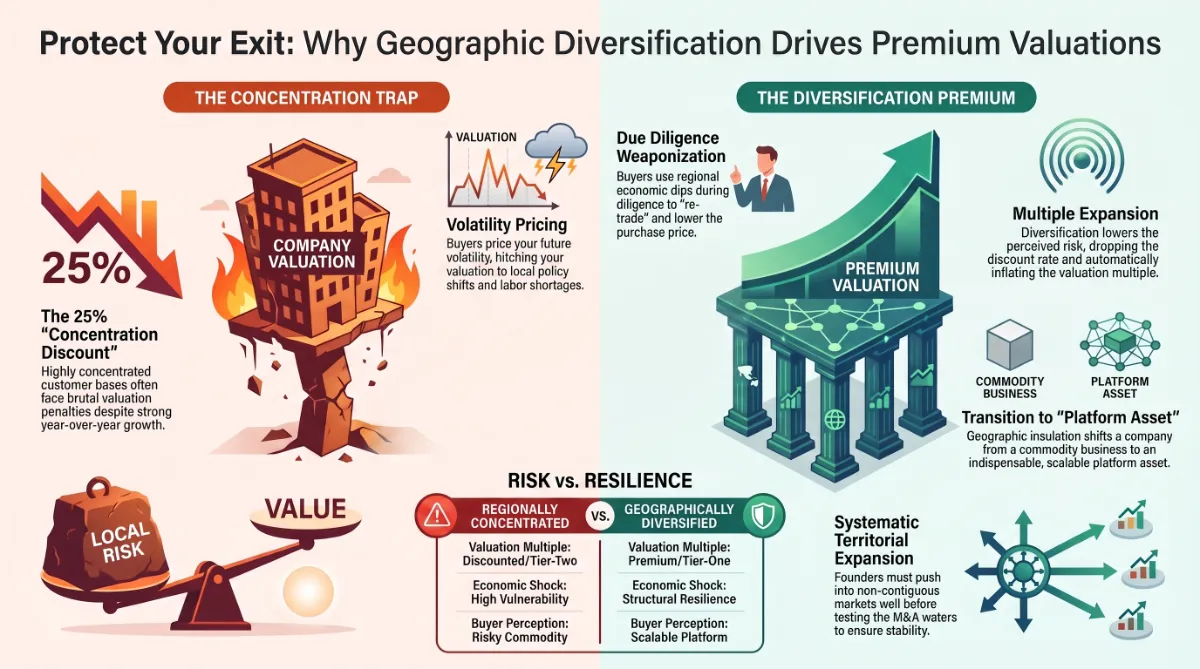
A mid-market logistics software founder recently sat in our conference room, stunned. His company boasted 35% year-over-year growth, pristine net revenue retention, and a highly polished product. Yet, the initial letters of intent (LOIs) arriving from private equity firms reflected a brutal 25% discount against his target valuation.
The fatal flaw wasn’t the software. It was concentration. Nearly 70% of his enterprise customer base was clustered within the industrial Midwest. When regional manufacturing growth slowed, private equity risk models flagrantly penalized his company.
Buyers do not just purchase your historic cash flows; they price your future volatility. When an enterprise isolates its operational footprint or customer base within a singular economic territory, it hitches its corporate valuation to local policy shifts, regional labor shortages, and localized macro downturns. To command premium multiples at exit, business owners must decouple their growth from local geography.
Fast Track Summary
-
Valuation Risk Mitigation: Expanding across distinct economic territories structurally lowers an enterprise’s cost of capital, directly inflating the valuation multiple applied by institutional buyers during an exit.
-
Arresting Buyer Leverage: Geographic concentration gives strategic buyers an easy excuse to chip away at your purchase price during due diligence by weaponizing localized macro risks.
-
Strategic Multiple Expansion: True cross-border or pan-regional operations position a company as an expandable platform asset, allowing founders to command premium tier-one acquisition multiples.
How Geographic Diversification Insulation Commands Premium Private Equity Multiples
Section Overview: Achieving a resilient geographic diversification market value insulates mid-market companies from localized macroeconomic shocks by spreading cash flow generation across non-correlated economic regions. Institutional acquirers and private equity firms reward this structural risk mitigation by applying lower discount rates to future cash flows. Consequently, geographically diversified firms command significantly higher valuation multiples at exit compared to regionally concentrated competitors.
When institutional buyers evaluate a mid-market enterprise, their underwriting models focus heavily on downside protection. A highly concentrated regional player is inherently exposed to local real estate collapses, state-level regulatory overhauls, or localized supply chain bottlenecks. If your revenue is tied to one primary territory, a localized downturn can completely cripple your trailing twelve months (TTM) EBITDA right as you launch an exit process.
[Regional Concentration] ---> Exposure to Local Shocks ---> Higher Discount Rate ---> Lower Valuation Multiple
[Geographic Diversification] ---> Smoothed Cash Flows ---> Lower Cost of Capital ---> Premium Exit Multiple
Savvy corporate buyers analyze revenue distribution through the lens of non-correlated assets. For example, a Texas-based oilfield services technology provider that successfully scales its operations into the North Sea and Latin American markets effectively breaks its dependency on the Permian Basin cycle. This geographic insulation is exactly how mid-market founders shift their position from a commodity business to an indispensable platform asset.
According to research published by McKinsey & Company, companies that systematically pursue geographic growth show a vastly superior ability to maintain stable valuation multiples through economic cycles. This stabilization occurs because institutional investment committees evaluate risk through a weighted average cost of capital (WACC) framework. When geographic concentration risk is eliminated, the perceived investment risk falls, the discount rate drops, and the enterprise valuation multiple automatically expands.
During an exit preparation phase, optimizing your geographic footprint is just as vital as cleaning up your balance sheet. Founders often spend millions chasing incremental product features while completely ignoring the structural fragility of their customer geography. Strategic buyers will gladly pay a premium for a business that gives them immediate, de-risked access to entirely new operational territories and customer demographics.
To capture these premium valuations, owners must shift from accidental regional growth to deliberate territorial expansion. This requires a systematic assessment of your current customer distribution and a targeted push into non-contiguous markets well before testing the M&A waters. Proactively executing this strategy is a cornerstone of maximizing your exit readiness and securing an elite transaction structure.
De-Risking Due Diligence by Neutralizing Regional Economic Concentration Liabilities
Section Overview: Regional economic concentration creates a significant vulnerability during M&A due diligence, giving buyers substantial leverage to renegotiate the purchase price. Geographic diversification eliminates these single-point-of-failure risks, preventing buyers from weaponizing localized market downturns, regional regulatory shifts, or localized labor constraints to justify post-LOI price reductions and aggressive indemnity terms.
The period between signing an LOI and closing a deal is the most hazardous phase of any corporate sale. This is where buyers deploy highly sophisticated due diligence teams to find hidden liabilities and justify a price reduction, commonly known as “re-trading.” If your business is highly exposed to a single state or region, any negative economic data from that specific territory during the 60-to-90-day diligence window becomes a weapon for the buyer’s legal and financial teams.
Consider a multi-million dollar digital healthcare platform centered heavily in the Southeastern United States. During due diligence, a major regional insurance carrier changes its reimbursement policies, or a state legislature passes restrictive compliance laws. Even if the company’s current financial metrics remain steady, the buyer’s risk profile spikes. The immediate result is an aggressive demand to restructure the deal, shifting cash at close into a conditional, high-risk earn-out or expanding the seller’s indemnity escrow.
[Localized Risk Event] ---> Due Diligence Re-Trading ---> Price Chipping / Expanded Escrows
[Multi-Region Footprint] ---> Diluted Risk Impact ---> Smooth Due Diligence ---> Secure Cash at Close
To counter this vulnerability, owners must build a robust geographic diversification market value into their operational DNA. When your revenue is cleanly distributed across multiple regulatory environments and distinct regional economies, a downturn in one territory is easily offset by stability or growth in another. This structural resilience completely neutralizes the buyer’s ability to claim that your business model is fragile or overly dependent on local conditions.
A powerful case study of this dynamic involved a specialized commercial services provider looking to sell. The company had built its foundation in California but spent the three years prior to their exit expanding into the Pacific Northwest and the Mountain States through targeted buyer sourcing strategies. When California enacted sweeping labor classification changes that increased operational costs, the founder’s diversified multi-state footprint proved that the business could absorb the localized shock without derailing its aggregate corporate margin. The deal closed at the original valuation because the buyer could not prove a systemic, company-wide vulnerability.
Relying on a single regional market is an unacceptable risk for any owner seeking a clean, high-value corporate handover. Buyers look for every possible excuse to discount your life’s work, and geographic concentration is one of the easiest targets. Elevating your company’s geographic profile transforms your organization from a localized operation into a highly defensible, multi-market enterprise that commands respect at the negotiating table.
Achieving this level of structural defense requires deep, intentional preparation and an expert understanding of how sophisticated buyers model risk. Founders should not navigate these complex valuation dynamics alone. Partnering with a dedicated advisory team to assess your current territorial exposure and model your defensible market value is an essential step in executing a flawless, lucrative corporate exit.
Key Takeaways
-
Depress Cost of Capital: Eliminating regional concentration lowers your enterprise risk profile, which directly compresses the buyer’s discount rate and unlocks higher valuation multiples.
-
Neutralize Re-Trading Tactics: A diversified geographic presence removes the buyer’s ability to weaponize localized economic or regulatory shifts to cut the purchase price during due diligence.
-
Create Platform Value: Expanding your footprint across non-correlated economic regions transforms your business into a scalable platform asset, attracting premium institutional and strategic buyers.
-
Insulate TTM EBITDA: Territorial diversification keeps your aggregate financial metrics stable, ensuring a localized downturn won’t crush your profitability right as you go to market.
Maximize Your Valuation
Navigating the complexities of mid-market corporate exits requires more than standard broker advice; it demands sophisticated financial engineering and an aggressive approach to positioning your enterprise asset. At Atlas Digital Capital, we specialize in helping founders optimize their corporate structures, eliminate concentration risks, and run competitive processes that attract premium institutional buyers globally. If you are a mid-market business owner looking to secure your legacy and maximize your hard-earned enterprise value, let’s discuss how to position your company for an elite exit. Connect with our senior advisory team today by visiting our Contact Us page to schedule a private, confidential consultation.
